Simulation
Realizable Systems (Chap 22.4)
Causality and spectral factorization (Chap 22.4)
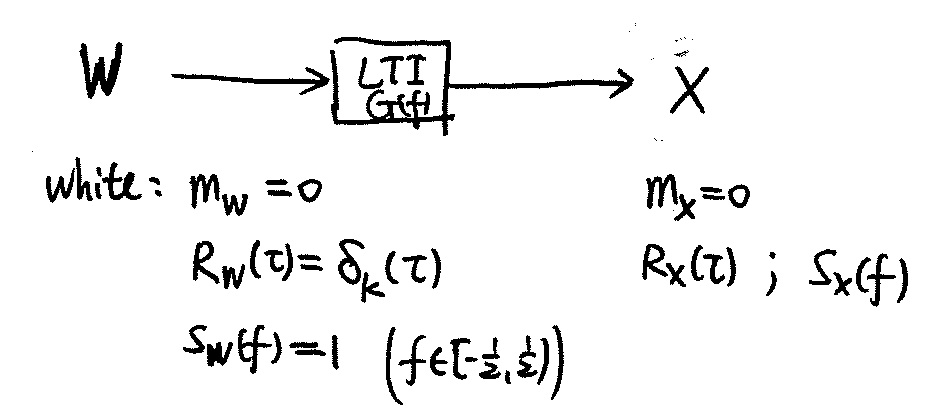
Simulating a w.s.s. Random Sequence (Chap. 15.4)
- \(\int_{-\frac{1}{2}}^{\frac{1}{2}} |\ln S_X{f}| \mathrm{d} f < \infty\)
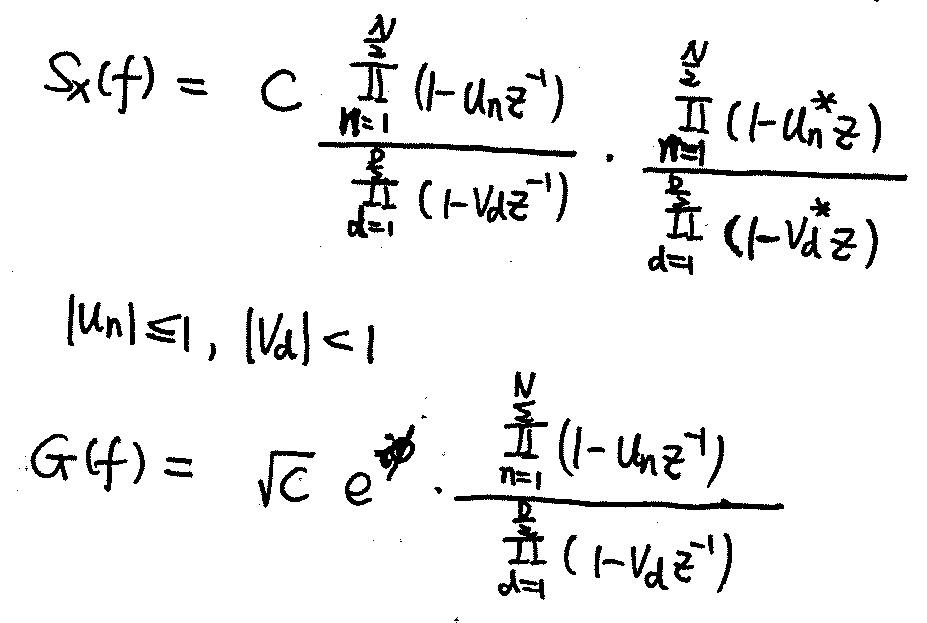
- \(G(f) = \exp{\frac{a_0}{2} + \sum_{n=1}^{\infty} a_n z^{-n} }\), where \(a_n = \int_{-\frac{1}{2}}^{\frac{1}{2}} \ln S_X{f} e^{i2\pi fn} \mathrm{d} f\), \(z=e^{i2\pi f}\)
- Causal iff \(G_Z(z)\) analytic on and outside unit circle.
- \(S_X(f)\) is real, then \(S_X(z)\) zeros/poles are in conjugate reciprocal pairs; \(S_X(f)\) is nonnegative, then \(S_X(z)\) zeros/poles are on unit circle and have even order; \(R_X(0) <\infty\), then there are no poles on unit circle
- on unit circle, \(z^{-1} = z^{*}\)
Simulating a w.s.s. Random Waveform
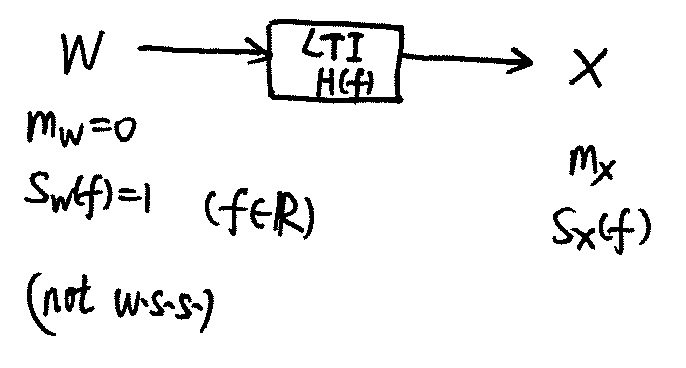
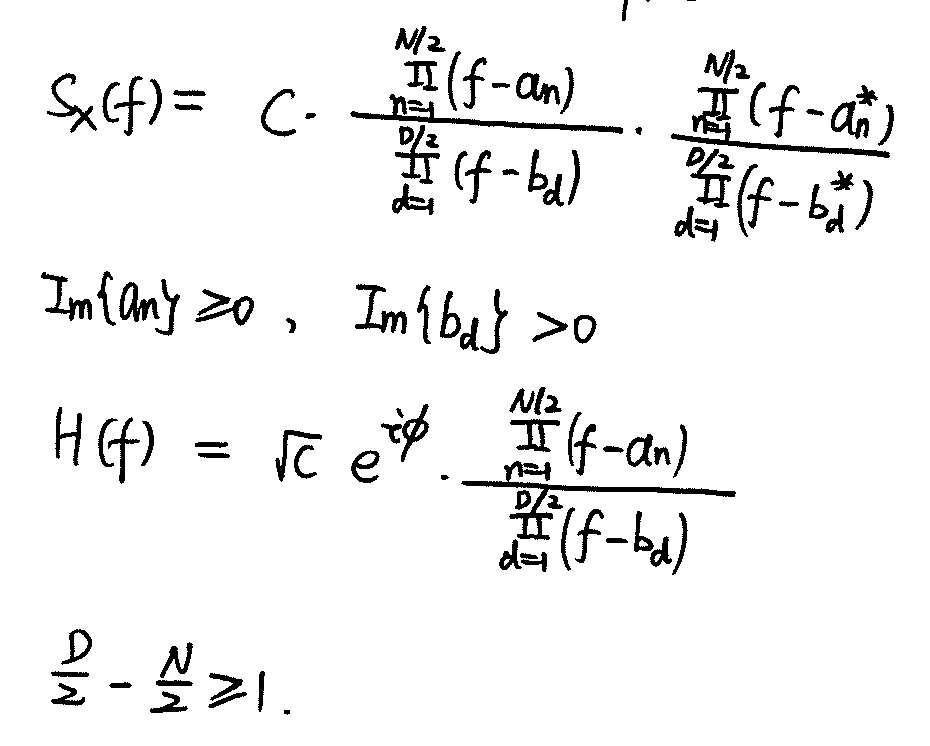
- \(S_X(f)\) is real, then zeros/poles are in conjugate pairs; \(S_X(f)\) is nonnegative, then \(S_X(z)\) zeros/poles have even order; \(R_X(0) <\infty\), then there are no real poles.
- Causal iff \(H(f)\) analytic on and below real line.
- \(X(u,t)\) being real implies poles/zeros of \(S_X(f)\) are symmetric about the origin.